Met's Bondy TOSCA: Be careful what you wish for, Martin!
I'm going to see it "at the movies" on Oct. 10, so I'll comment then. For now, I'll just note that the dichotomy "traditional/innovative" does not map squarely onto the dicthotomy "rock/suck," or vice-versa.
Tuesday, September 22, 2009

Monday, August 31, 2009
Tuesday, August 11, 2009
Sorry if that last post left a despairing taste in the mouths of those dropping by here. I certainly did have an end-of-era feeling when I heard that news and wrote the post, but my wife reminds me that I most likely will not be following anyone into the dark night just yet, and in case, it's not my belief that a dark night is what necessarily awaits any of us, so let's move on.
Since the Met RING last May I've seen SIEGFRIED and TURANDOT at the Washington National Opera. Should give you a quick rundown on those soon.
I've also spent three weeks in Strasbourg, with a side-weekend in Paris, and a spot of farhrening auf der Autobahn as well. No opera, though, alas: I was there to teach law (my day-job).
I thought about dashing to Munich, but what I most wanted to see their was Jonas Kaufmann as LOHENGRIN, but that was sold out, and the production, from what I hear, weakens my reticence about using the term "eurotrash." (No production should be condemned sight unseen -- I've learned that -- but even the German critics and public thought director Richard Jones had some 'splaining to do.)
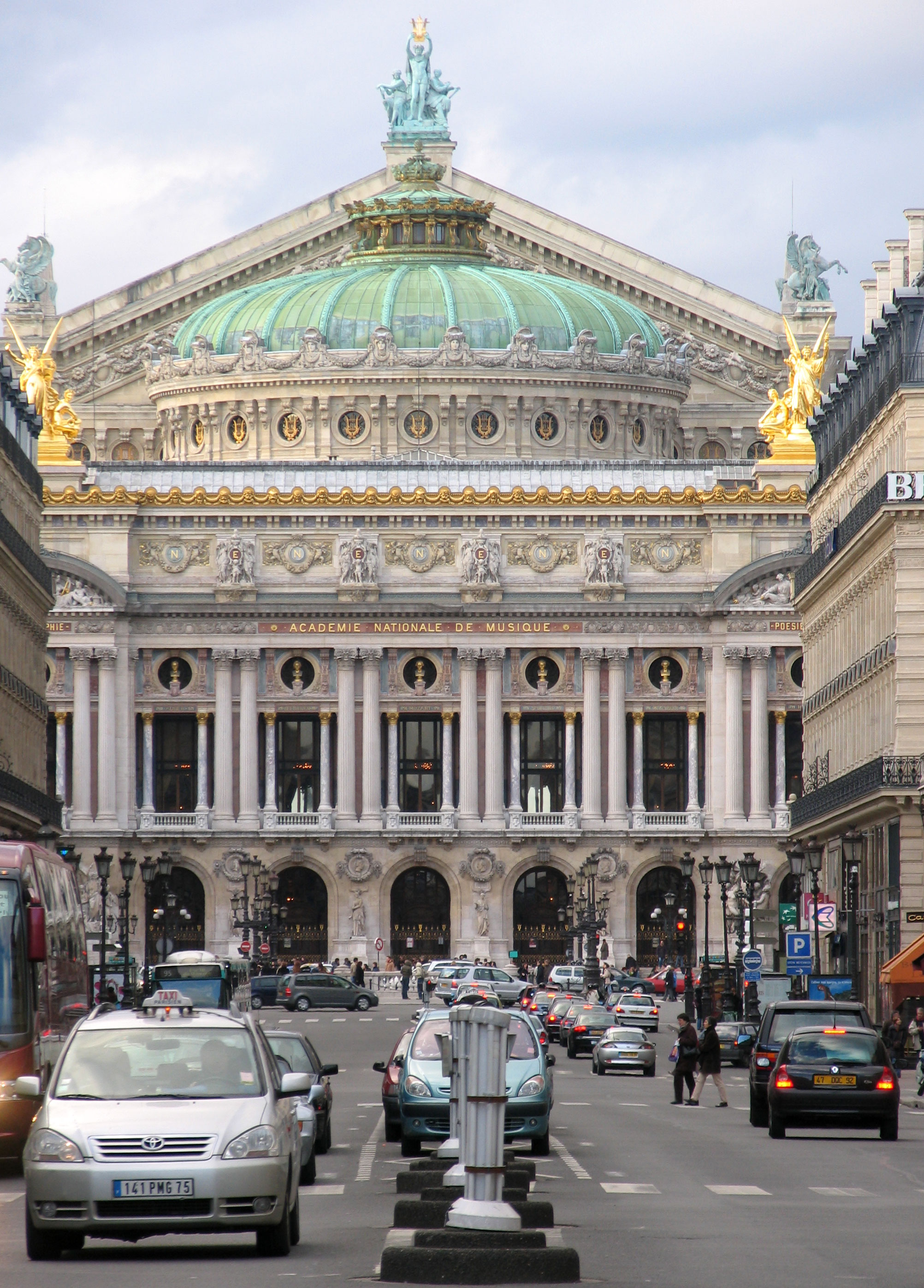
We did see something we very much wanted to see -- not in an opera house, but on one: Apollo's Lyre, atop the Opera Garnier in Paris. This statue plays a major role in one chapter in Gaston Leroux's novel The Phantom of the Opera, the scene that corresponds to the final scene of Act I of Andrew Lloyd Webber's show (the most faithful adaptation of the nover ever done, btw). My daughter was very, very pleased!
Since the Met RING last May I've seen SIEGFRIED and TURANDOT at the Washington National Opera. Should give you a quick rundown on those soon.
I've also spent three weeks in Strasbourg, with a side-weekend in Paris, and a spot of farhrening auf der Autobahn as well. No opera, though, alas: I was there to teach law (my day-job).
I thought about dashing to Munich, but what I most wanted to see their was Jonas Kaufmann as LOHENGRIN, but that was sold out, and the production, from what I hear, weakens my reticence about using the term "eurotrash." (No production should be condemned sight unseen -- I've learned that -- but even the German critics and public thought director Richard Jones had some 'splaining to do.)
We did see something we very much wanted to see -- not in an opera house, but on one: Apollo's Lyre, atop the Opera Garnier in Paris. This statue plays a major role in one chapter in Gaston Leroux's novel The Phantom of the Opera, the scene that corresponds to the final scene of Act I of Andrew Lloyd Webber's show (the most faithful adaptation of the nover ever done, btw). My daughter was very, very pleased!
Sunday, July 5, 2009
Sandra Warfield, RIP
Farewell to another hinge of my childhood, since I grew up with the Metropolitan Opera Record Club Record series in which Sandra was frequently found in important secondary roles.
Perhaps her voice was not big or durable enough for a star career, but it was a smooth and attractive upper-contralto sound -- as attractive, in a maternal sort of way, as the famous photo of her that MORC and RCA always used, the one where she's looking back over her shoulder....
When I was in my senior year at Yale (and a classmate of Jimmy's and Sandra's daughter Ahna, class of 1980 -- like you, Richard Slade!), they both came to campus. Jimmy gave a master class, and Sandra gave a song recital at Sprage Hall. She still sounded lovely, and I got a chance to talk to her backstage and tell her how much she -- and that photograph! -- had meant to me as I learned about opera. That generation is dying out....
Farewell to another hinge of my childhood, since I grew up with the Metropolitan Opera Record Club Record series in which Sandra was frequently found in important secondary roles.
Perhaps her voice was not big or durable enough for a star career, but it was a smooth and attractive upper-contralto sound -- as attractive, in a maternal sort of way, as the famous photo of her that MORC and RCA always used, the one where she's looking back over her shoulder....
When I was in my senior year at Yale (and a classmate of Jimmy's and Sandra's daughter Ahna, class of 1980 -- like you, Richard Slade!), they both came to campus. Jimmy gave a master class, and Sandra gave a song recital at Sprage Hall. She still sounded lovely, and I got a chance to talk to her backstage and tell her how much she -- and that photograph! -- had meant to me as I learned about opera. That generation is dying out....
Sandra… bontà! Sandra… dolcezza!
Ah, camminiamo insieme un'altra volta
Ah, camminiamo insieme un'altra volta
così, con la tua mano nella mia mano.
Dove vai ben so.
Ed io ti seguirò per posare a te vicino
nella notte che non ha mattino.
Dove vai ben so.
Ed io ti seguirò per posare a te vicino
nella notte che non ha mattino.
Sunday, May 10, 2009
GÖTTERDÄMMERUNG
Loge's fire and the Rhine's waters ended the world and the Schenck/Schneider-Siemssen RING last night in fine style.
Loge's fire and the Rhine's waters ended the world and the Schenck/Schneider-Siemssen RING last night in fine style.
Linda Watson's wobble was gone. Instead, she simply shone as Brünnhilde. Is she Flagstad? No, but she's a keeper, if she keeps on like this. Likewise Jon Fredric West, who showed not a trace of the too-common diminution of voice in the Act III narrative, and who even sang with some soft sadness -- within the limits of his instrument, which tends towards the fortissimo-only setting -- in the death scene.
Margaret Jane Wray, from whom your reporter saw an effective Ortrud three years ago, was radiant as Gutrune. Great things coming here. Our Gunther was Iain Peterson, who showed an impressive baritone voice, while his bio shows confusion as to whether he's a baritone or a bass. Pick baritone and stick with it, I'd say. Fwiw, in an effort to strengthen the weak character of the Gibichung chieftain, he did the DFD bellow on "greife dich immer," leading to a well-staged fight with Hagen -- Sir John Tomlinson, practically perfect in every way.
Richard Paul Fink made the most of this opera's short but important Alberich scene -- and once again did his little curtain-call dance as he took his solo bow at the end of the Act II. Another audience favorite. Has anyone noticed that in this production, Alberich's cape, already seen in RHEINGOLD, has grown to regal proportions in GÖTTERDÄMMERUNG? Bravo, Mr. Langenfass!
Norns: the First doubled the Erda of earlier evenings, as is traditional, and had an acceptable exponent in Wendy White. Numbers Two and Three did not, however, double Waltraute and Gutrune, respectively. The Second Norn was sung respectably by Elizabeth Bishop, and the first evening's Freia, Wendy Bryn Harmer, had a true star turn as the Third Norn. Later, Yvonne Naef worked her now-familiar magic as Waltraute, setting aside Fricka's hauteur for the Valkyrie's despondent humility, but with the same plangent mezzo sound.
Last Monday's Rhinemaidens -- Lisette Oropesa, Kate Lindsey, and Tamara Mumford -- returned, popping up downstage with a pert ta-daaa gesture and familiar fine voices: a fitting light opening for the act the ends the world.
A few advantages of seeing this spectacular production from the Family Circle: though you miss the Rainbow Bridge in RHEINGOLD, you see the River Rhine at certain points in GÖTTERDÄMMERUNG where I'm sure you can't see it from "better" seats; e.g., off to the right in Act II, and off to the left and upstage in Act III Scene I (except for the little downstage estuary in which the Rhinemaidens cavort).
Günther Schneider-Siemssen took a bow with Levine. [EDITED TO ADD: But see comments infra. Seems I was wrong about who was taking that bow, but I stand by the remarks that now follow.] He deserves to: not only for this production's set designs -- though that would be enough -- but also: how many designers have done back-to-back RINGs, at the Met or anywhere? Yes, GSS was the set designer of the previous RING as well, the so-called "Karajan RING." He is diversely talented. Since 1967, when the Karajan WALKURE premiered at the Met, no other designer has done a RING opera at the Met (except for visitors from outer space like the Kirov in '07). That's 42 years, and counting until the proposed opening of the LePage production in 2012....
Günther Schneider-Siemssen took a bow with Levine. [EDITED TO ADD: But see comments infra. Seems I was wrong about who was taking that bow, but I stand by the remarks that now follow.] He deserves to: not only for this production's set designs -- though that would be enough -- but also: how many designers have done back-to-back RINGs, at the Met or anywhere? Yes, GSS was the set designer of the previous RING as well, the so-called "Karajan RING." He is diversely talented. Since 1967, when the Karajan WALKURE premiered at the Met, no other designer has done a RING opera at the Met (except for visitors from outer space like the Kirov in '07). That's 42 years, and counting until the proposed opening of the LePage production in 2012....
Will the LePage production be the good kind of modern production, as opposed to, you know, the sucky kind? Will there even be a LePage production after all, or will this one live again? Will it be stored and be seen in the future? Singe, Schwester, dir werf ich's zu: weisst du, wie das wird?
Saturday, May 9, 2009
SIEGFRIED
Jon Fredric West gets through this killer role with his voice and energy intact, reliable volume, some attempts at lyricism, decent if not melting sound, comic touches that never cross the line to the inappropriate, and an obvious sense of enjoying what he's doing. Can a Siegfried today do better?
He's a burly guy. A snarky reference to World Wrestling Entertainment was overheard by your reporter at intermission. Well, maybe Siegfried is a big guy, d'you ever think of that?
West is "in it" at every moment, e.g. reacting constantly to Mime, and even (I've never seen this before) looking over his shoulder to see where that bass-baritonal laughter is coming from when he's just killed Mime. And that reminds me, Richard Paul Fink made the most of the SIEGFRIED Alberich -- there's a lot of it to make, though only in one act -- and he proved an audience favorite.
Linda Watson still has a wobble. Well, WALKÜRE was just two nights earlier! But she delivered a lyrical "Ewig war ich" with an on-pitch an un-forced "leuchtender Spross."
James Morris was the other great audience favorite, and he and Levine did their "two Jimmies" thing again at final curtain calls. Robert Brubaker excelled as Mime, Wendy White gave a good mezzo-but-alas-not-contralto rendition of Erda, and the Unseens -- Tomlinson as Fafner and Lisette Oropesa as the Forest Bird -- were superb. Now curtain calls for the latter two, though.
Production note: Sitting were we are -- Family Circle, scrape-the-ceiling territory -- has its disadvantages. Couldn't see the Rainbow Bridge, for example. (!!) However, we had a great view of Fafner the Dragon, seen in this production as Jabba the Hutt's country cousin. From where we sat, his eyes blinked and his mouth moved, as his lines required. The speaker from which Sir John's awesome vocal portrayal emerged was placed right at the mouth. Bravo.
Wednesday, May 6, 2009
Curtain call question
Since the Met preserves the venerable tradition of curtain calls act-by-act in front of the curtain -- instead of the lame Broadway style where everyone comes out lamely under a lamely raised curtain and bows lamely on the lamely illuminated lame final set -- a question sometimes come up with special acuteness w/r/t Act II of SIEGFRIED (it could come up with B'way style curtain calls too -- did I mention that these are lame? -- but the Met style highlights it): should singers of unseen characters take bow?
My answer is yes: the soprano who sings for Forest Bird and the bass who sings Fafner the Dragon have legitimately sung important roles. As long as they're willing to put on something better than rehearsal clothes for the purpose, they should take a bow.
The consensus answer, however, has been no. I have never seen a Forest Bird or a SIEGFRIED Fafner get a curtain call (tho' I assume it's different in those productions, like Chereau's, where the Dragon turns back into his rightful form as a giant after Siegfried skewers him).
Some say: no costume, no bow. I say that's silly -- but if you insist, OK, let the soprano carry out some feathers and a beak with her, and maybe the bass can drag the giant-crab contraption after him on a leash. Seriously, though, why (tomorrow night) can't Lisette Oropesa and Sir John Tomlinson take bows in presentable non-costume clothing?
I ask because -- and here's the point -- Sir John wants to, and means to.
I could tell you how I know this, but then I'd have to kill you. Or not, but I'd just as soon you worried about it.
Subscribe to:
Posts
(
Atom
)